
Code School x Loretto House

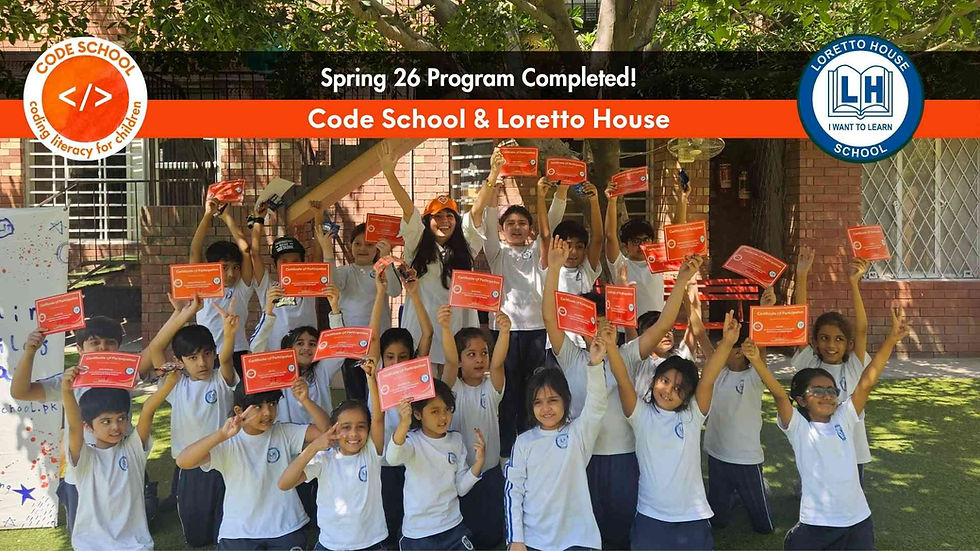
Code School Wraps 2026 Program at Loretto House, Lahore: Building Early Computational Thinkers in the Classroom
Code School has successfully completed its 2026 coding literacy program at Loretto House, Lahore, marking a cycle of structured computational learning embedded directly into the school timetable. The program introduced primary students to foundational coding and problem-solving skills designed to strengthen logic, creativity, and analytical thinking by learning coding.
Unlike traditional extracurricular models, the program was integrated into the school day, ensuring consistent exposure and progression. Students worked through guided coding exercises and game-building activities that encouraged them to move from following instructions to designing and testing their own ideas.
Reflecting on the collaboration, Sadaf Rehman, Co-founder and CEO of Code School, said:
“Coding literacy is giving students the ability to think and solve problems in a digital space. When children learn to code early, they learn how to break problems down and build solutions step by step. That skill transfers everywhere.”
From the school’s perspective, the impact was visible in how students engaged with structured thinking over time.
The program focused on early exposure to computational thinking as a core learning skill, aligned with the growing global shift toward integrating technology literacy into primary education. With many education systems now embedding coding into national curricula, such initiatives reflect how schools can begin preparing students earlier for a technology-driven future.
A student from Grade 1 shared: “My favorite part was making my unicorn game!”
Across the sessions, students demonstrated increasing confidence in sequencing logic, identifying patterns, and applying structured thinking to creating games in block coding on the Scratch platform. The emphasis remained on experiential learning.
As the program concludes, it leaves behind a classroom experience where coding was not treated as a separate subject, but as a way of thinking embedded into learning itself.


Comments